
 Français
 English
 Español
 Deutsch
 Italiano
 Português
 Türkçe
 Polski
 Русский
 Nederlands
 Čeština
 Română
 Svenska
 Dansk
Dansk
 Latviešu valoda
 Suomi
Suomi
 Українська
 български
 Magyar
 العربية
 Ελληνικά
 Eesti
Eesti
 Slovenčina
 Lietuviškai




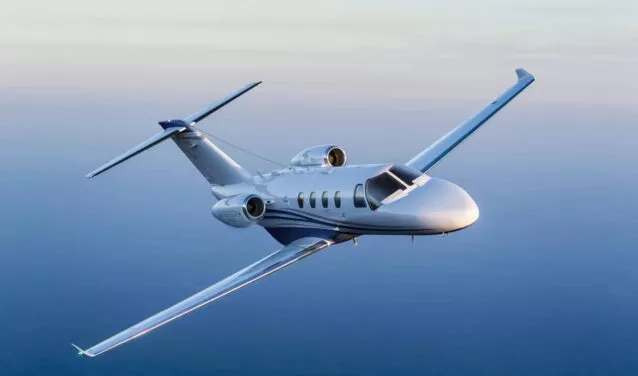
It’s very simple! On the ground, to get from one city to another, we travel on roads that have been designed and calculated by civil engineers to ensure safety, comfort and logistics. An air corridor is the same principle, but for air transport.
Read on to find out everything you need to know about this concept.
How do the air corridors work?
Airways are the invisible network that structures the sky. To understand how aircraft travel safely, it is essential to understand how these lanes are organised and managed.
1. Definition of the air route
An air corridor is essentially a three-dimensional air route, with a width of around 19 kilometres and a defined vertical thickness, which aircraft follow to travel from one point to another according to strict rules.
These navigation points can be :
- Ground radionavigation installations transmitting on specific frequencies;
- Intersections of signals (radials) from several ground beacons ;
- More recently, precise geographical coordinates used by satellite navigation systems.
2. Traffic control and safety
Air safety relies on aircraft being in constant contact with a control centre. The main role of the air traffic controller (or air traffic controller) is to ensure the horizontal separation and vertical spacing of aircraft to prevent any collision, whether on the ground or in flight.
- On the ground: The controller directs the aircraft along marked taxiways, in a similar way to taxiing.
- In the air: It adapts the aircraft’s route to ensure that it avoids any other aircraft.
The air corridors also provide a safety margin in relation to obstacles on the ground, set at a minimum of 1000 feet (around 300 metres) in flat areas and 2000 feet (around 600 metres) in mountainous regions.
3. Managing traffic jams
To manage traffic jams (often due to adverse weather conditions rendering a runway unusable, for example), the controller can ask aircraft to enter holding patterns.
These aircraft are then staggered in stacks: at a constant altitude, each aircraft performs standard holding patterns until traffic can be cleared and landing authorised.
How do you communicate in an air corridor?
Communication between the air traffic controller (in charge of air traffic control) and the aircraft is via radio communications. The latter uses a range of frequencies strictly reserved for aeronautical use to avoid any interference.
The controllers at the regional air traffic control centres work in teams and are relieved every two hours. This regular rotation is essential to maintain their decision-making potential and guarantee safety.
In the approach sectors, where the aircraft’s descent phase is managed, all the aircraft converge on the same landing trajectory. The minimum space between them is then reduced to just 3 nautical miles.
To ensure universal and rapid understanding, controllers communicate with pilots exclusively in English.
French airspace management
The Directorate of Air Navigation Services (DSNA) is the sole provider of air navigation services in France, in accordance with European regulations. It is responsible for air traffic control in French airspace, both in mainland France and overseas.
Let’s take a quick look at how it works:
1. Organisation and control centres
French airspace is divided into five Area Control Centres (ACC) located in Aix-en-Provence, Athis-Mons (near Orly), Bordeaux, Brest and Reims.
Within these regional areas, the airspace is subdivided into en-route control sectors.
Each sector is managed by a team of controllers who can monitor up to 25 aircraft simultaneously, the exact number depending on the complexity of the traffic.
As they progress, aircraft move from one sector to another, changing frequency to communicate with the controller in charge of their next zone.
2. The approach and heavy traffic
For the arrival phase, the “en route” controllers hand over to the approach controllers. It is this team that ensures the smoothness and safety of landings in the vicinity of airports.
The number of air corridors is constantly increasing in order to manage traffic. This trend is particularly noticeable on the approach to Paris-Charles de Gaulle international airport (Roissy), where more than 1,300 movements (take-offs and landings) are recorded every day.

