


 Français
 English
 Español
 Deutsch
 Italiano
 Português
 Türkçe
 Polski
 Русский
 Nederlands
 Čeština
 Română
 Svenska
 Dansk
Dansk
 Latviešu valoda
 Suomi
Suomi
 Українська
 български
 Magyar
 العربية
 Ελληνικά
 Eesti
Eesti
 Slovenčina
 Lietuviškai

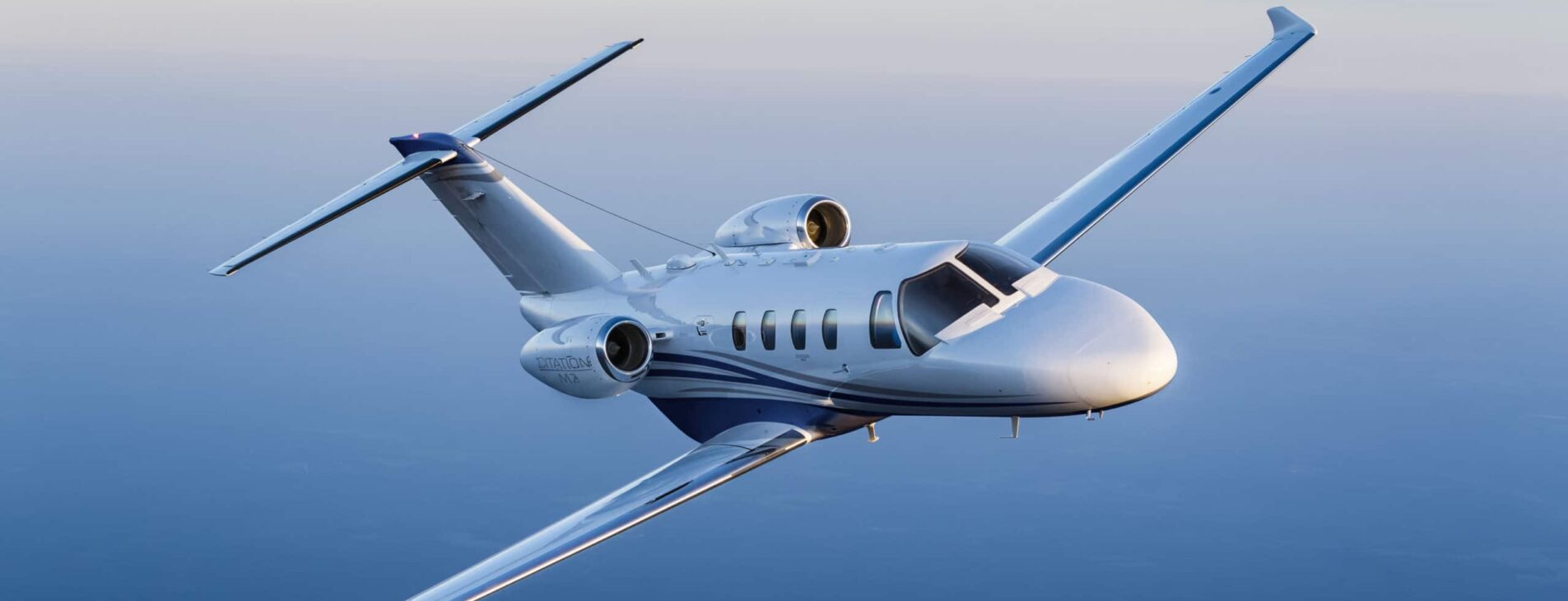
Cessna is an aerospace manufacturer like Dassault or Bombardier, part of the Textron Aviation group. Thus, Cessna joins the other aircraft manufacturer: Beechcraft.
This company specializes in final aerospace assembly, manufacturing private jets and turboprops, particularly for civil aviation, for large aircraft and business aviation.
Let us revisit the history of this manufacturer in the aerospace sector, in the aerospace market, and discover all the ranges of devices and the fleet of this aircraft manufacturer.
Cessna today:
Some figures:
Today, the aircraft manufacturer Cessna belongs to the global giant Textron Aviation.
The company has 15,000 employees worldwide.
And, the company’s revenue, generated in Europe, amounts to 22.6 million euros in 2021.
A committed aerospace manufacturer of private jets:
The time has come for the race to reduce pollution. Cessna does not deviate from the rule and is committed to providing a greener Earth for future generations.
That’s why Cessna commits to:
-
- designing the interiors of aircraft with recyclable and more “green” components.
- using clean fuel (SAF) for a greener sky.
- reducing its carbon emissions by 50% by 2050.
Additionally, the company Cessna sets ambitious goals in terms of sustainable development by 2025:
-
- a 20% reduction in greenhouse gas emissions
- a reduction in the use of water by 10%.
- a reduction of 10% in energy consumption.
- a reduction of 10% in waste.
The beginnings of the Cessna aircraft manufacturer
- 1911: The story begins in Kansas, USA, with a farmer named Clyde Cessna. This true aviation enthusiast builds his first plane made of wood. That year, the first aircraft is launched for the American manufacturer Cessna.
- 1924: With a friend Walter Beech (the future founder of Beechcraft), they join forces to create an aviation company. However, opinions diverge on the types of aircraft models to manufacture, and the two partners create their separate companies.
- 1927 : Clyde Cessna then founds the company of the same name in Wichita, a city in Kansas. Aircraft, such as the Cessna DC-6, are then created, and the first aircraft orders come in.
- 1932 : Unfortunately, the economic crisis hits the company hard, which finds itself under a roller. It is then that the Great Depression forces the company to close its doors. The company remains dormant for some time.
- 1934: A pilot friend of Clyde Cessna loses his life in one of his planes, which already, at the time, flies at high speed. Very affected by this loss, Cessna decides to cease all aeronautical activity.
The revival of the Cessna aircraft company
- 1934: Dwight and Dwane Wallace are brothers, but also, and above all, the nephews of Clyde Cessna. They are the ones who buy the company to get it back on its feet, make it take off, and contribute to the success that the company enjoys today.
- The 1940s: During this decade, several light aircraft have been manufactured such as the Cessna 120, Cessna 180, and Cessna 195. This period benefits the family business. Indeed, they made a delivery of about thirty Cessna t-50 aircraft destined for the U.S. Air Force as well as 180 aircraft for the Royal Canadian Air Force.
- 1956: The Cessna 172 is then one of the most manufactured light aircraft in the aerospace world. The manufacturer is in the top three of the general aviation sector along with Beechcraft and Piper.
- 1963 : The Cessna aircraft manufacturer signs the production of its 50,000th aircraft! Unsurprisingly, it is one of its flagship aircraft, a Cessna 172.
The arrival of Cessna business jets
- 1968 : The first single-engine business aircraft makes its appearance. It is the Cessna 500 Citation I. It performs its first flight in airspace , the following year. These aircraft are certified for Public Air Transport, and pilots must justify professional pilot training and qualifications and licenses to operate this type of aircraft.
- 1975: In 12 years, the company has doubled the production of its single-engine aircraft (single engine). This is because they reach a total of 100,000 aircraft created.
- 1985: The American aerospace company is acquired by General Dynamics.
- 1992: It is now Textron Aviation’s turn to acquire the Cessna company. The company continues its production of business jets with its Citation line.
- 2014: Textron Aviation acquires two other aerospace companies. Thus, Cessna joins the trio produced by Textron with the aircraft manufacturers Beechcraft and Haker. This grouping allows for an expansion of its commercial aviation product range. Indeed, Textron Aviation meets various needs such as medical repatriation, air cargo requests, private aviation, and group flights.
The Cessna aircraft fleet
Today, the aircraft manufacturer Cessna stands out with 3 different fleets. The first is a fleet of turboprops (the “Turboprop”). Then, there is the “Piston” category. Finally, Cessna develops and enjoys strong success with its business fleet and its Citation series, far from propeller aircraft.
Citation Longitude
It is the largest jet private jet powered by the aerospace manufacturer Cessna.
On board, up to 12 passengers can travel safely and in comfort. This is why it makes an ideal jet to transport a vice president, for example.
Its range extends to 7,400 km thanks to a reasonable fuel consumption. This allows for a long-haul flight such as Paris – New York, for example, as well as a medium-haul flight, corresponding to about eight hours of flight.
Moreover, this comfortable and quiet cabin also has very efficient air filtration. A simulator proves that HEPA filters eliminate almost 100% of viruses, bacteria, and other germs present in the air.
Also, its cockpit features the latest flight control technologies and simplified access to the controls.
Example of fare per route: Paris – New York: starting from €70,000.
Citation Latitude
With a maximum capacity of 9 people, this jet with streamlined lines for maximum speed, is part of the intermediate private jets category.
Its range of 5,300 km guarantees medium-haul trips with full onboard equipment.
Its contemporary, bright, and comfortable cabin places this business jet among the most refined in its avionics category.
Example of fare per route: Paris – Athens: starting from €22,500.
Citation XLS
This intermediate jet can carry up to 10 people (and up to 12 for the Citation XLS Gen 2). The private jet is designed with a range of 3600 km. That is why , this business jet allows non-stop connections between several cities in Europe, for instance.
On the other hand, this tourism aircraft is perfectly suited for airports with short runways or difficult access.
Of course, like the other jets in the Citation line, the comfort in the cabin is undeniable.
Example of fare per route: Paris – Marrakech: starting from €17,000.
Citation Mustang
This ultra-light private jet is very practical and ideal for a trip of up to 4 people, being under 2 hours of flight.
It has an excellent price/quality ratio. That is why it is highly sought after.
In addition to the qualities it offers, the Mustang has the ability to access airports with short runways. It is practical for short flights without a large amount of luggage.
Example of fare per route: Paris – Geneva: starting from €12,000.
Discover other Cessna Citation aircraft still active in business aviation: Citation I, Citation II, Citation III, Citation VI, Citation VII, Citation X, Citation Sovereign, Citation CJ1, Citation CJ2, Citation Encore, Citation Bravo, Citation Excel (the older version of the XLS), Citation Jet.
The other two ranges from the Cessna aircraft manufacturer.
Cessna offers two other fleets of aircraft. They are the “Turboprop” and “Piston.”
The former includes three turboprops. The Grand Caravan EX and the Cessna Caravan can accommodate up to 14 passengers. It is worth noting that these two models cover routes of about 1,500 km.
In the United States, for example, these models are very commonly used as regional jets.
Then, the last turboprop is the Cessna SkyCourier, which can make group flights for up to 19 passengers.
Finally, the last range of aircraft that completes the Cessna fleet is the “Piston” category. It is a range of aircraft with a single engine (they are single-engine) dedicated to pilot training but also for recreational aviation. Consequently, these planes will not be used for business aviation.
Cessna’s “Air Ambulance” mission.
Another mission that an airline’s airliner cannot perform: the “Air Ambulance.”
The numerous business jets from Cessna, all with different characteristics, share a common ability to be adaptable and perform medical flights.
This is the case, for example, with the Citation XLS models, offered in the list above, that can serve as transporters.
These multi-faceted aircraft can be requisitioned for repatriations or medical deliveries.
Stretchers can also be installed within their cabins, along with all necessary medical equipment.
Charter a Cessna aircraft with AEROAFFAIRES.
At AEROAFFAIRES, we do our best to select the business jets that suit you. If you wish to book your private flight on a Cessna Citation aircraft, contact us at +33 (0)1 44 09 91 82 by email at charter@aeroaffaires.com or fill out our online quote.


