Français
 English
 Español
 Deutsch
 Italiano
 Português
 Polski
 Nederlands




Since February 28, the military escalation between the USA, Israel and Iran has profoundly altered the security environment in the Middle East. Joint US-Israeli operations against Iran have triggered Iranian retaliatory strikes in several countries in the region, with a direct impact on airspace, airports and transport flows.
For business aviation, the situation is not theoretical. It immediately translates into airspace closures, complex reroutings, flight suspensions and heightened tension around certain strategic infrastructures.
At AEROAFFAIRES, we are monitoring these developments on an ongoing basis in order to accurately assess the operational consequences for our customers.

A military escalation with regional effects in the Middle East
According to an update published by International SOS at 11:30 GMT on March 2, US and Israeli military operations against Iran are continuing on a massive scale.
Strikes are targeting :
– missile launch sites
– air defense capabilities
– infrastructures linked to the nuclear program
– government and military sites
Iran announced the death of Supreme Leader Ali Khamenei and the establishment of a transitional council. At the same time, Iranian retaliation intensified across the region.
While a large proportion of missiles and drones have been intercepted, some civilian infrastructures have been hit, including major airports in the Gulf states.
The Strait of Hormuz remains a point of strategic tension, with an increased risk of disruption to maritime traffic.
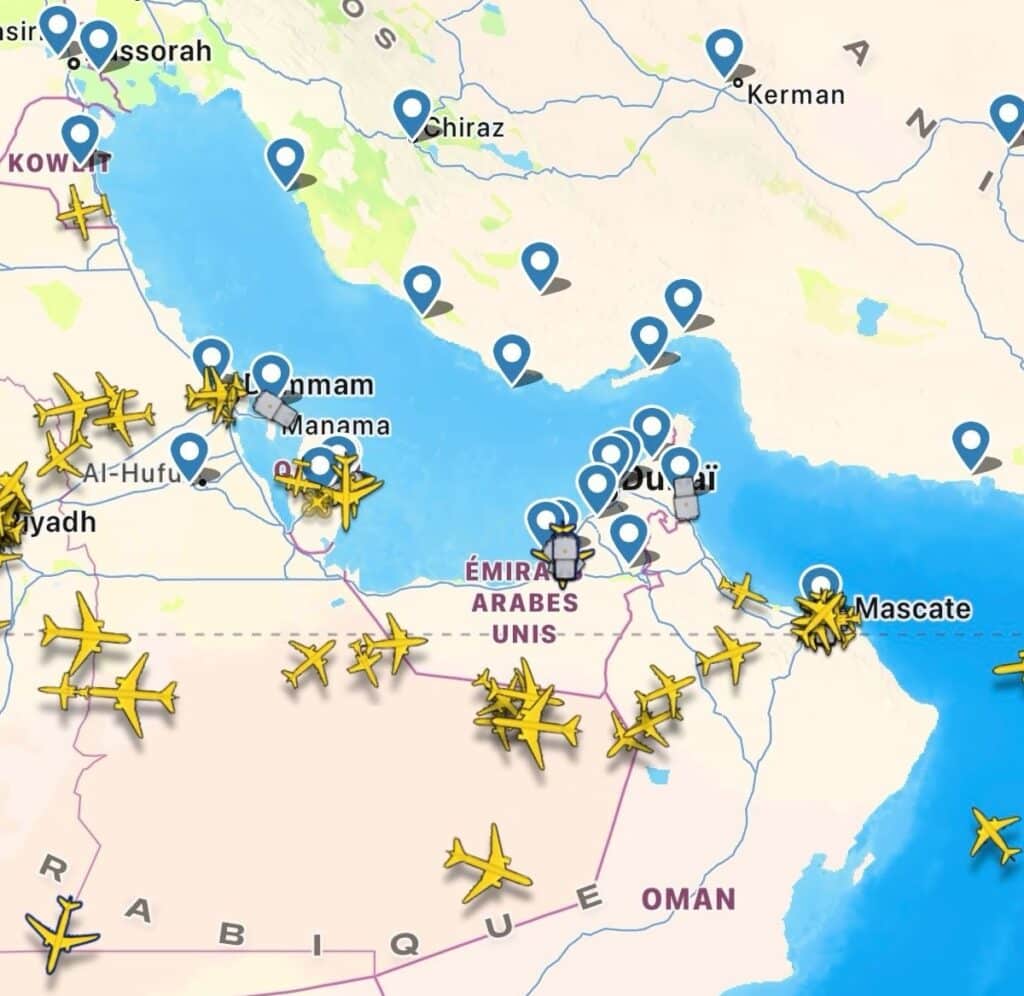
Closed airspaces in the Middle East: an evolving situation
As of March 2, several airspaces are totally or partially closed:
– Israel: airspace closed until March 6, 1000 UTC
– Iran: airspace closed
– Bahrain, Qatar, Kuwait: temporary closures
– Iraq and Syria: extended closures
– United Arab Emirates: partial reopening with restricted routes
– Oman: open with temporary adapted routes
– Saudi Arabia: open
Jordan operates at reduced capacity, with around 56% of normal overflight volume.
In practical terms, this means :
– permanent modification of flight plans
– longer journey times
– slot constraints
– anticipated congestion as soon as the airport is fully reopened
For a private jet flight, this may mean additional technical stopovers, finer fuel management, or the prior repositioning of the aircraft.
Security risks and operating environment in the Middle East
The report’s analysis highlights several areas of concern:
– possible extension of Iranian targets to civilian infrastructures
– a sustained pace of strikes over the coming days
– collateral risks linked to interceptions
Countries hosting US military bases or Israeli diplomatic missions could maintain prolonged restrictions and tighten security around sensitive sites.
Even if the overall security environment does not deteriorate across the board in all the countries concerned, the risk of targeting errors or isolated incidents remains.
Recommendations for travel to the Middle East
In particular, the briefing recommends :
– postpone all travel to Iran
– postpone travel to Israel and the Palestinian Territories
– postpone travel to Bahrain, Egypt, Kuwait, Jordan, Oman, Qatar, Saudi Arabia, United Arab Emirates and Iraq until March 4
Non-essential travel to Lebanon and Syria is also inadvisable.
In this context, each mission must be analyzed individually. There is no uniform response.
What this means for business aviation in the Middle East
For international companies, family offices or general management operating in the region, the question is not just whether a flight is possible, but under what conditions it can be operated safely and under control.
Under these conditions, each mission must be prepared with precision:
– constant monitoring of NOTAMs
– close dialogue with certified operators
– identification of alternative hubs outside risk zones
– anticipation of crew constraints
– precise assessment of insurance and liability
In some cases, it may be more appropriate to reposition to a stable hub such as Muscat or Riyadh before organizing the rest of the trip.
The AEROAFFAIRES approach to the Middle East
In times of geopolitical instability, the role of a broker is not limited to finding an available aircraft.
Our responsibility is to :
– analyze air restrictions in real time
– coordinate with operators and local authorities
– secure alternative routes
– support our customers in their strategic decisions
Safety remains the top priority. Continuity of operations only comes after clear parameters have been validated.
Our aviation experts are on call 24 hours a day to :
– assess missions in progress
– adapt flight plans
– organize urgent repositioning
– accompany evacuations if necessary
An evolving situation in the Middle East
The report indicates that operations could continue for several days, or even weeks.
In such a fluid environment, operational discipline is essential.
Decisions must be based on verified sources, a thorough understanding of the regional context and rigorous coordination.
Sources :
- Insight Report – International SOS
- International SOS, Crisis Update : ” US-Israeli military operation against Iran, Iranian retaliatory strikes to continue in next 24 hours “, published on March 2, 2026 at 11:30 GMT