Français
 English
 Español
 Deutsch
 Italiano
 Português
 Polski
 Nederlands




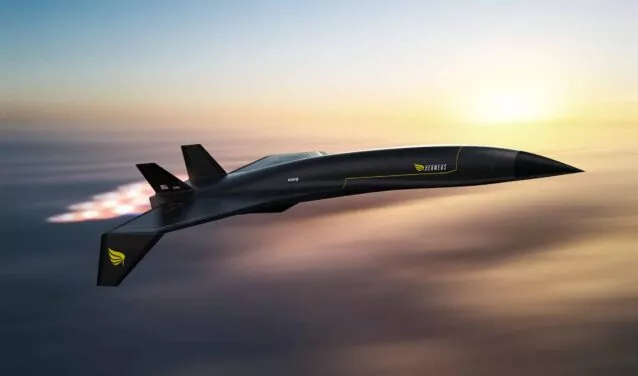
American company Hermeus, founded in 2018, is pushing the boundaries of aviation with a project as bold as it is ambitious: the development of a hypersonic private jet, dubbed Quarterhorse. Their slogan, “The future is faster”, perfectly embodies their vision of a future where traveling in a Mach 5 aircraft becomes a reality.
In this article, we introduce you to the Hermeus Quarterhorse, its technical specifications and outstanding performance, and then look at how they are setting themselves apart in the race for fast aviation.
Finally, we detail the project’s development timetable and its future applications in the military, government and private sectors.
Outstanding speed: Mach 5, over 6,000 km/h
The Quarterhorse won’t just be a supersonic jet, but a hypersonic aircraft capable of reaching Mach 5, or 5 times the speed of sound – the equivalent of 6,174 km/h. At this speed, a flight from Paris to New York could be completed in just 90 minutes, compared with the 7.5 hours currently required for a commercial flight.
This would make it the fastest reusable aircraft in the world. By way of comparison, the legendary Concorde – in service from 1976 to 2003 – flew at a maximum speed of just over Mach 2.
hermeus: a different vision of ultra-fast flight
While other companies such as Boom Supersonic are developing jets flying at supersonic speeds (Mach 1 to Mach 2), Hermeus is focusing on hypersonics. An even more advanced technology that could see the light of day in the same timeframe as competing projects.
To ensure the safety of the initial test phases, Hermeus prototypes will be autonomous, avoiding the risk of endangering pilots during live flight tests.
@Hermeus Quarterhorse
A project supported by the US Air Force and NASA
In August 2021, Hermeus received $60 million in funding from the US Air Force, a major boost to the development of the Quarterhorse. The partnership has several objectives, including the certification of a new combined-cycle turbine engine, based on a GE J85 turbojet engine.
“We’re very excited to see Hermeus translate its proven success in engine prototyping into flight systems,” says Joshua Burger, Lieutenant-Colonel in charge of the Vector Initiative program.
The U.S. Air Force supports the Hermeus project, and Hermeus became a NASA partner in February 2021.
A clear timetable for the first hypersonic flight
With the support and resources assembled for the development of the project, Hermeus has drawn up a progressive roadmap:
- 2023: the first test with a small model of autonomous aircraft;
- 2025: creation of medium-sized autonomous aircraft for freight transport;
- 2029: introduction of a commercial passenger aircraft.
Although the cost of a ticket aboard this business jet has not yet been revealed, it is likely to be a very high-end service, reserved for urgent business trips or strategic missions.
a revolution in global transport
The Quarterhorse will revolutionize the world’s transport network, and that could be of interest to many! In addition to the US Air Force’s military interest in the project, the jet could also be used for governmental and political purposes, as well as for business travel.
Travelling at speeds in excess of 6,000 km/h would save around 80% of travel time! In a world where time is money, the Hermeus private jet is the perfect solution!
Charter a private jet with AEROAFFAIRES
While you’re waiting for the Quarterhorse to arrive, AEROAFFAIRES can optimize your time by chartering a private jet tailored to your needs.
Our AEROAFFAIRES aviation experts are at your service 24/7 for your private flight at +1845 373 3456 / +44 84 4986 0547.
Don’t hesitate to visit our online quote to get a price estimate for your private jet.